
Sara Gharib
United States
Neural Pathways Shaped by CHD8: Insights from Conditional Gene Editing
Sara Gharib¹, Rifah Saima¹, Esther M. Garfield¹, Samantha Dhanani¹, Arinne Hoque¹, Muhammad O. Chohan², Jeremy Veenstra-VanderWeele², Rebecca Muhle¹
1. Department of Neuroscience & Behavior, Barnard College of Columbia University, New York, NY, USA
2. Department of Psychiatry, New York State Psychiatry Institute and Columbia University Irving Medical Center, New York, NY, USA
Abstract
Background
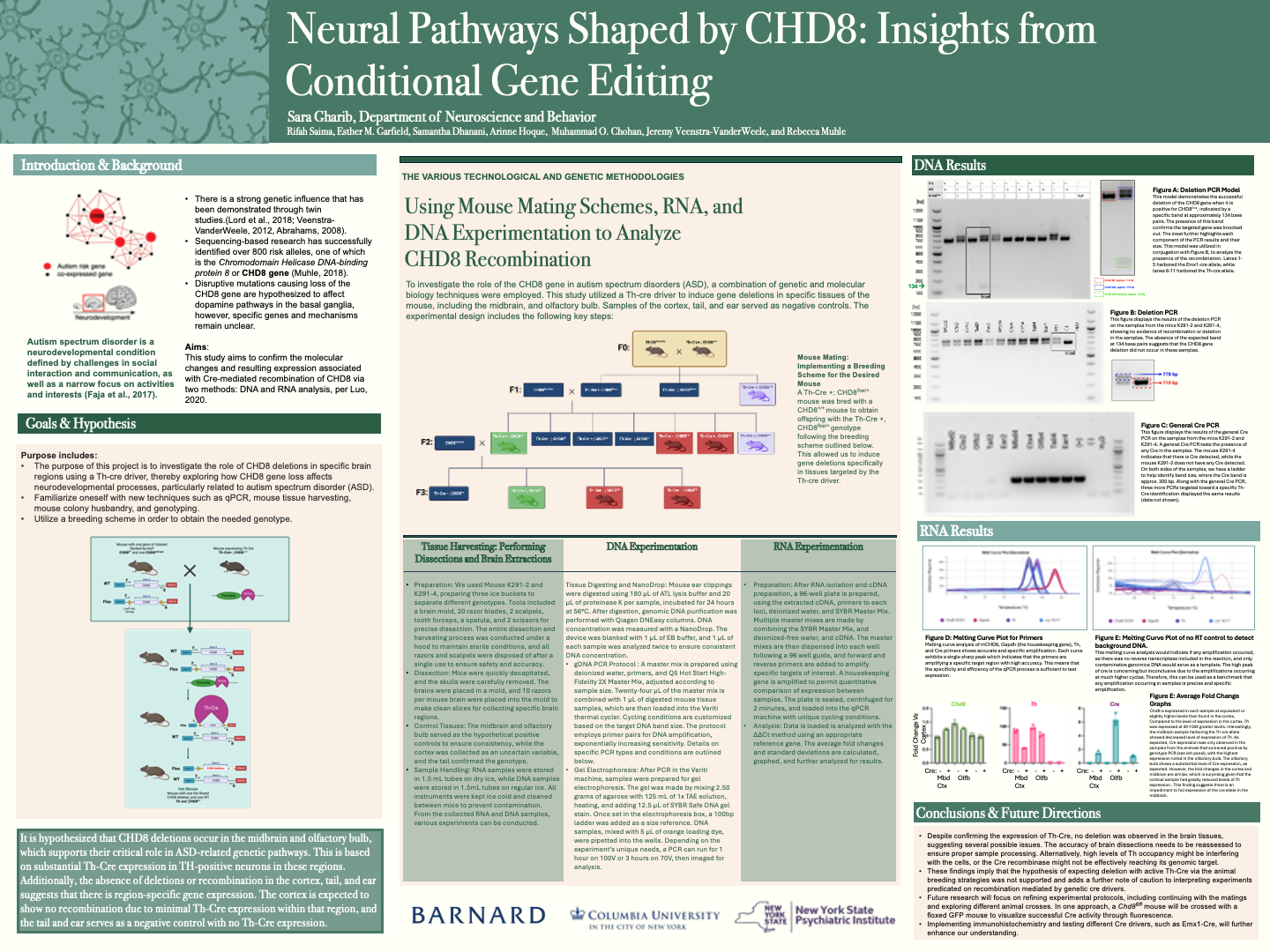
Autism spectrum disorder (ASD) is a highly heritable neurodevelopmental condition, and disruptive variants in CHD8 remain one of the strongest genetic risk factors. Although CHD8 has been proposed to regulate dopamine-related pathways, particularly within midbrain populations, the molecular consequences of region-specific Chd8 loss are not fully defined. This study aimed to evaluate the efficiency of Cre-mediated recombination of Chd8 using a Th-Cre driver and to assess downstream gene expression changes across dopaminergic and non-dopaminergic brain regions.
Methods
A Th-Cre; Chd8^flox/+ breeding scheme was used to generate offspring with dopaminergic-specific deletions. Brain dissections targeted the midbrain and olfactory bulb as predicted sites of recombination, while cortex, tail, and ear tissue served as negative controls. Genotyping, deletion PCR, and Cre PCR were performed to detect recombination events. qPCR was used to quantify expression of Chd8, Th, and Cre, with melt-curve analyses confirming primer specificity.
Results
Th and Cre expression were robustly detected in dopaminergic tissues, confirming appropriate regional expression of the driver. However, deletion PCR showed no detectable recombination of the floxed Chd8 allele in either the midbrain or olfactory bulb. qPCR further demonstrated that Chd8 expression remained comparable to cortical control regions, indicating a lack of effective Cre-mediated excision. These results suggest that the Th-Cre driver did not successfully target the Chd8 locus, potentially due to incomplete Cre penetrance, dissection variability, or chromatin-level constraints limiting recombination efficiency.
Conclusions
Our findings highlight a significant limitation in using Th-Cre to induce conditional Chd8 deletion within dopaminergic circuits. The absence of detectable recombination underscores the need for careful validation of Cre driver performance in gene-editing studies. Future directions include refining dissection protocols, continued strategic matings, incorporating a floxed-GFP reporter to visualize Cre activity, and testing alternative drivers such as Emx1-Cre. This work contributes to understanding the technical barriers in modeling ASD-associated gene disruptions and informs the selection of more reliable approaches for studying Chd8-dependent neurodevelopmental pathways.
Leave A Comment